by
Jon Webb, Mike Bloxham & Craig Slawson
2005
Data last updated: June 2019
Published by:
Staffordshire Ecological Record
The Wolseley Centre, Wolseley Bridge, Stafford. ST17 0WT
Insects, and in fact all invertebrates, always seem to be ignored when assessing the biodiversity of an area, partly because they are often small and insignificant and partly because many are difficult to identify correctly. There are exceptions – butterflies, moths and dragonflies do get some recognition, but this only covers a relatively small number of species.
Staffordshire Ecological Record is pleased to be able to produce this checklist, the twentieth in its occasional series of publications, for one of the more economically important groups, the bees wasps and ants, collectively known as Aculeate Hymenoptera. This has only been possible through the work of the two primary authors and an enthusiastic band of amateur and professional entomologists.
At this juncture there are insufficient records to produce a full atlas for Staffordshire (ref. Page 20), but we hope this checklist will stimulate some interest in the group within the recording community in Staffordshire, which may result in an atlas in the future.
As a new venture, this checklist is also being published on the Internet where future updates and new records will also be posted, hopefully on at least an annual basis.
G.Craig Slawson (Series Editor)
My interest in the Aculeate Hymenoptera was kindled when looking through an invertebrate report from a heathland. A large list of Andrena, Nomada, Lasioglossum and others was present and from this point onwards I was fascinated to see what these animals looked like in action. When I did start to collect and survey I was not disappointed. In general, Aculeate species are attractive, have interesting behaviour with bizarre and fascinating lifestyles.
It soon became apparent, however, that there was a lack of information on these species for Staffordshire (VC39). I therefore took the decision to attempt a provisional checklist based on reliable records and specimens.
I must make apologies at this stage. Although I have been studying Aculeates for four years, I am still not keen to determine a number of the more difficult groups myself. Therefore, in going through museum collections and personal collections I have only confirmed those species that I am sure about. Others will therefore often appear in the text as ‘not confirmed’ – I therefore strongly point out that this is a provisional checklist.
I must stress that that document is a provisional list and there is little doubt in my mind that there is (and probably will always be) plenty more work required to fully understand this group within Staffordshire.
As a general entomologist of some experience and with a commitment to invertebrate conservation in Britain, I have become interested in the potential of insect groups in habitat evaluation studies. There has been some encouraging progress here and it may give added impetus to entomological survey, breathing fresh life into biodiversity initiatives which currently threaten to stagnate into ‘action’ on a limited number of flagship species about which much is already known.
With the assistance of many others, I have intermittently studied aculeates in Staffordshire for over twenty years and am delighted to have been asked to assist in this valuable exercise.
As an arachnologist, I am the ‘foreigner’ in this collaboration. Although, as a general entomologist, I have an interest in Hymenoptera, I cannot claim to have any expertise in their identification or biology. However, as Ecological Records Co-ordinator for Staffordshire Wildlife Trust and manager of Staffordshire Ecological Record (SER), it has been my responsibility to computerise all the records, both contemporary and historical and in this capacity I have also designed the routines to produce the checklist.
Apart from the authors, many local and national enthusiasts have supplied records of bees and wasps over the years, far too many to mention individually, but the majority of records were supplied by the following recorders, to whom the authors express their sincere thanks for their efforts:
Publication of this checklist would not have been possible without the valued support and funding offered by JCB Ltd., the British Entomological & Natural History Society (BENHS) and Staffordshire Biodiversity Action Plan (SBAP).
The order of species and scientific names used in the checklist are based upon those proposed by Bees Wasps and Ants Recording Society (BWARS).
We would also like to thank Mike Edwards, Staffordshire Wildlife Trust and the Potteries Museum for their valued assistance in the production of this work. Maps produced in this checklist have been generated using DMap courtesy of Dr. Alan Morton.
Red Data Book category 1 – Endangered Species which are known or believed to occur as only a single population within one 10km square of the national grid.Red Data Book category 2 – Vulnerable Species declining throughout their range or in vulnerable habitats.Red Data Book category 3 – Rare Species which are estimated to exist in only fifteen or fewer post 1970 10km squares. This criterion may be relaxed where populations are likely to exist in over fifteen 10km squares but occupy small areas of especially vulnerable habitat.Nationally Notable (Scarce) category A – Notable A Taxa which do not fall within the RDB category but which are none-the-less uncommon in Great Britain and thought to occur in 30 or fewer 10km squares of the National Grid or, for less well recorded groups between eight and twenty vice counties.Nationally Notable (Scarce) category B – Notable B Taxa which do not fall within the RDB category but which are none-the-less uncommon in Great Britain and thought to occur in 31 and 100 10km squares of the National Grid or, for less well recorded groups between eight and twenty vice counties.Nationally Notable (Scarce) – Notable Species which are estimated to occur within the range of 16 to 100 10km squares. The subdividing of this category into Notable A and Notable B has not been attempted for many species in this part of the review.
Very Rare found in 1-15 10km squares, 1970 onwards, in which respect it is similar to Red Data Book species.Rare found in 16-30 10km squares, 1970 onwards, in which respect is similar to Nationally Scarce Category A species.Scarce found in 31-70 10km squares, 1970 onwards, in which respect it differs from Nationally Scarce Category B species, which are found in 31-100 10km squares, 1970 onwards.Restricted found in more than 70 10km squares, 1970 onwards, and in the Institute of Terrestrial Ecology (ITE) Land Classification groups 1 and 2 (Southern Lowlands, South-West and Southern Coasts). Roughly this is about half of England.Widespread found in more than 70 10km squares, 1970 onwards, and in Institute of Terrestrial Ecology (ITE) Land Classification groups 3 and 4 (Midland Lowlands and central Coasts) besides 1 and 2. Widespread species extend into the coastal areas of south-west Scotland but not into Northumbria.Universal found in more than 70 10km squares, 1970 onwards, and further Institute of Terrestrial Ecology (ITE) Land Classification groups, particularly 7 and 8 (Northern Lowlands and North-Western Seaboard). Roughly this is the whole of Wales, Scotland and England, including Northumbria.
Cleptoparasite An insect that steals (eats) the provisions of another. In the case of bees and wasps this also often involves killing the intended reciprocate: the larvae of another bee or wasp.Lekking A lek is territory set up by males in the breeding season. Lekking is defending and holding such territory against potential rivals.Aculeate An animal with a stinging organ. In the case of the bees, wasps and ants the sting is a modified ovipositor.Hymenoptera An immense order of insects, the typical specimen having two pairs of membranous wings (hymen = membrane) coupled together by a row of tiny hooks.Parasite An animal or plant that lives in or on another (host) from which it obtains nourishment.Parasitoid An insect that is parasitic as a larva but becomes free-living when adult.
The Victorian age, with its spirit of diligent enquiry and delight in classification, encouraged a considerable number of entomologists, amateur and professional, throughout the British Isles. The outpouring of publications during this era saw Sir Oswald Mosley produce the seminal Natural History of Tutbury (1863) – a work which can claim to lay the foundation of formal entomological recording in the county. It was also remarkable in that it included not only information on Lepidoptera (the focus of so much contemporary attention) but an abundance of other insects. The Hymenoptera records therein, mostly compiled by Edwin Brown, formed the basis of the first Staffordshire list in the Victoria History of the County of Stafford (part 1. 1908.).
The study of Aculeates[1] nationally was given a considerable boost by the publication in 1896 of the Hymenoptera Aculeata of the British Islands, by Edward Saunders. This was to be the standard work on the group for many years and the author was to be of considerable personal assistance to a number of Staffordshire workers in confirmation of identifications, J.R.B.Masefield being a case in point. The Bombus and Psithyrus records of Masefield and B. Bentley are reviewed by B.Bryan, in 1921[2]. It almost goes without saying that contemporary churchmen had an important hand in study of Aculeates. Staffordshire had three redoubtable representatives in the shape of Rev. F.C.R.Jourdain, Rev. F.D.Morice and Rev. H.W.Daltry. As with most of their contemporaries, they were excellent general naturalists also finding time to give detailed study to Aculeates. Along with much other work, Jourdain compiled the Victoria County History list, Morice was an expert on several aculeate families, and Daltry had a profound influence on the recording of flora and fauna in the county at large.
Active during the early part of the twentieth century was L.A.Carr. Nephew of Prof. J.W.Carr of Nottingham Natural History Museum, Carr was an enthusiastic Hymenopterist, covering many different groups. He was a gifted taxonomist, recording mainly from the Lichfield area. A correspondent with many eminent figures such as Schmiedeknecht and C.Morley, he did not seem to regard Aculeates with any particular affection, his paper indicating that he handed his specimens over to Morice for identification. In his own words ‘I have not indicated the relative frequency of the species as I only collected them very occasionally and then only took one or two even if numbers were seen.’ Brevity of information has proved to be something of a general obstacle when reviewing these records for inclusion in a contemporary list.
Whilst Rev. T.W.Daltry had been influential in earlier times, the work of his son H.W.Daltry was to be very significant in the history of local invertebrate studies as the century moved on. Collecting material from a variety of insect orders, he concentrated for a considerable period on Hymenoptera, collaborating with H.Britten, a notable entomologist both at local and national level. He also referred material to Dr. O.W.Richards, arguably the most eminent Hymenopterist of the day.
More recent times have seen the formation of the Staffordshire Invertebrate Group comprised of individuals currently interested in insects in which D.W.Emley and M.Waterhouse were particularly active. The latter actively collected Aculeates from a number of sites, whilst the former along with much other valuable research, produced a provisional manuscript check list based on the work of the aforementioned entomologists.
Other members of the group, including the present authors, recently undertook to expand Aculeate survey, partly in response to current national biodiversity initiatives but in particular to the attempts being made by the Bees, Wasps and Ants Recording Society (BWARS) to evaluate the current status of all Aculeates nationally. Today sees the work unfolding, with the assistance of notable members of BWARS such as Dr. M.E.Archer and S.J.Falk (Warwick Museum), who have not only checked identifications, but have also collected in the county themselves.
It is hoped that this paper will encourage workers to fill in the obvious gaps in our knowledge, enabling the production of a Staffordshire Biological Recording Scheme Publication on Aculeates in the near future.
Aculeate roughly translates to ‘with a sting’. It includes all the Hymenoptera in which the ovipositor of the females is modified solely as a sting (Betts 1986). In the UK this is a relatively small group (645 species currently on the British List) but contains some of the most well known (both loved and hated) insects in the Country. Of these, perhaps the better-known ones are the social bees, social wasps and ants; all of which are easily recognisable. Bumble bees (humble bees) and the honey bee are well known to everybody, especially the gardener who frequently comes across the large and impressive animals visiting flowers; they have been the focus of many a song, poem and story in English folklore. Ants are also universally known and although they have a reputation for being industrious, people generally take offence if this industry leads to them being found indoors around foodstuffs. Wasps are generally seen in a more jaded perspective as mean and aggressive troublemakers. The popular view on wasps can vary tremendously from outright fear to complete indifference. There are not any other creatures (except perhaps spiders) of this size which can have such an astounding affect on people. They are, however, just as industrious as ants and bees and play a very important role in keeping down the numbers of other insects present in England.
Despite the fact that the social bees and wasps are the most well known of the aculeates, they actually only make up a very small proportion of the overall species numbers of this group. The vast majority of the aculeate hymenoptera are solitary bees and wasps, which are very varied in size and colour. These also include a small number of wingless species such as the velvet ants (actually a group of primitive wasps which attack the young of other wasps species) but the vast majority are winged. Varying degrees of social behaviour can be seen within these species. Many are purely solitary, some nest in aggregations and others share nests and responsibility (this partial social behaviour is termed eusocial). In the UK, the solitary bees and wasps range from the tiny (2-4mm) aphid hunting wasps up to the very large and impressive bee-wolf (Philanthus triangulum), up to 25mm, and the wool carder bee, Anthidium manicatum, which is the size of a bumble bee.
| Family | Common Name | No of Spp |
| Dryinidae | 34 | |
| Embolemidae | 1 | |
| Bethylidae | 22 | |
| Chrysididae | rubytail wasps | 33 |
| Tiphiidae | 3 | |
| Mutillidae | velvet ants | 3 |
| Scoliidae | 1 | |
| Sapygidae | 2 | |
| Formicidae | ants | 67 |
| Pompilidae | spider-hunting wasps | 44 |
| Vespidae | social wasps and potter wasps | 34 |
| Sphecidae | solitary wasps | 131 |
| Family/subfamily | Common Name | No of Spp |
| Apidae | bees | |
| Colletinae | mining bees | 21 |
| Andreninae | mining bees | 71 |
| Halictinae | sweat bees | 60 |
| Melittinae | solitary bees | 6 |
| Megachilinae | leaf-cutter bees | 39 |
| Anthophorinae | flower bees | 44 |
| Xylocopinae | carpenter bees | 1 |
| Apinae | honey bees and bumble bees | 28 |
| TOTAL | 645 |
Social insects include some species of the aculeate hymenoptera and the termites (Isoptera).The social aspect of the bees, wasps and ants has been the subject of human curiosity for over 2000 years; the first documented observations coming from Aristotle’s observations in the third century B.C.
There are ten species of social wasp which have been recorded within the UK and one, Polistes dominulus, is almost certainly a vagrant species. Probably the most stunning of these is the Hornet (Vespa crabro), one the largest British insects and definitely one of the most feared. It is in fact, probably the most docile of the social wasps and tends not to be particularly aggressive. The remaining species are all superficially similar and are often termed as the ‘common wasp’ although this could actually be any one of the nine species. These now include a couple of relatively new arrivals to the UK. Having appeared in the last two decades, these have tended to spread rapidly northwards over successive years.
Of the social bees, there is one native honey bee (Apis mellifera) and a further 27 bumble bees. The indigenous honeybee has been bred by beekeepers to produce strains that are both docile and produce plentiful amounts of honey. Honeybee nests can survive for very long periods of time and the queens and workers tend to overwinter by feeding on excess honey. The bumblebees have a similar lifestyle but do not overwinter because they do not produce enough honey for overwintering. Instead, an old colony dies but freshly mated queens hibernate over the winter emerging in early spring to start colony building all over again.
There are also a number of eusocial species amongst the solitary bees. These include certain Halictus spp. and Andrena spp. in the UK. Eusocial species tend to share the same nest but there is generally little or no cooperation between the females.
One of the key aspects about the aculeate hymenoptera is the need for a specific nesting site. In the case of many of the bees and wasps, food (pollen for bees and arthropod prey items for wasps) is collected and stored in these nesting areas to be later consumed by the larvae. Parasitic and ‘cuckoo’ species, although not constructing a nest of their own, still require the nests of other hymenoptera which they exploit. There are only a few species of aculeates in the UK that do not build their own nests or require the nests of others to survive.
Most bees and wasps are miners and burrow in the ground. In temperate climates about 70% of the nest building species are ground nesting, often favouring south-facing banks and cliffs, unstable slopes and field paths; particularly when bare or sparsely vegetated (Jones and Munn 1998[1]).
There are, however, other species which nest in pre-existing cavities in cliffs, trees and very often in man-made structures. Old beetle borings and exit holes are also often used in fence posts and old trees. Another useful nesting site utilised by such species are hollow stems of brambles, umbellifers and other plants. There are also a few species in the UK that construct their nests. The most notable of these is the potter wasp (Eumenes coarctatus), which builds vase-like nests on rocks and plants.
Perhaps some of the better known nests are those within brick and mortar. These ‘masonry bees’ often dig nests into old and poor quality concrete in houses and other structures. Potter wasps and other solitary wasps species will also often utilise cavities in walls for nests. House walls, especially old south facing ones, can be a very profitable place to search for Aculeate Hymenoptera.
Other nesting materials are also often needed, dependant on the particular species. For instance, the wool carder bee (Anthidium manicatum) lines and partitions its brood cells with the hairs gathered from the leaves of lamb’s ear and mullein whereas the red mason bee (Osmia rufa) partitions them with a mud clay.
In the UK, all bees tend to stock their nests with pollen whereas wasps stock their nests with arthropod prey items. One of the main reasons for there being a high number of different types of bees and wasps is the degree to which they specialise on specific food items. Bees can collect pollen from a variety of different plants (polylectic), or they are specialists, taking nectar from only one, or a few closely related species (oligolectic). There is also a high degree of variation between the flight times of different species; some are spring fliers, others are found on the wing only in mid or late summer.
All the wasps also tend to specialise to a certain degree. Some species may take flies, whilst others will only collect large hairless caterpillars or spiders. Other species show a higher degree of specialisation; Symmorphus mutinensis preys only on the beetle, Phyllodecta vulgatissima whereas the Bee-wolf (Philanthus triangulum) preys chiefly on honey bees.
Parasitism, Parasitoids and Cuckoo Species There are a large number of species in the aculeate hymenoptera that show some degree of parasitism. This parasitism is often directed against the young larval stages of other species rather than the adults. The parasites involved tend to enter the nests of host species when the adults are away collecting food. The parasite will then lay its eggs on or near any foodstuff collected by the bee or wasp and then make its escape. This egg hatches quickly and the young parasitic larvae kills (and often eats) the host larvae as well as eating the foodstuff collected by the host adult. These parasitic bees and wasps are often quite specific. Nomad bees (Nomada spp.) are often specific to one or a handful of Andrena species; Sphecodes spp. generally attack sweat bees (Lassioglossum spp.) and rubytails (Chrysididae) are often associated with potter wasps.
Aculeates are considered to be a very useful group to indicate habitat quality (Archer 1998, Jones and Munn 1998). Most of the bees and wasps generally require a complex of different habitats and micro-habitats that contain different resources. These resources will include nesting sites (dead wood or bare exposed ground) as well as other habitats containing nectar and pollen sources. There may also be further requirements such as nest materials. Such different resources are often only found in traditional countryside patterns (Kirby 1995) and the presence therefore of a large number of aculeate species within a specific area is often a good indicator of micro-habitat diversity and structural diversity. In many areas these countryside patterns have given way to intensive agriculture that contains little diversity. Because of this many species show a very restricted distribution and over 50% of the aculeates species on the national list are now considered to be under threat (Archer 1998[2]).
Certain areas of the County have not been well covered. Over the last ten years more work has been undertaken in the southern and central areas of the vice county; the north being rather sparsely covered.
Although there is not a large amount of information on the aculeate hymenoptera of Staffordshire, there have fortunately been a number of surveys carried out on various heathlands within the County over the last six years (Falk et al 1996, Bloxham & Slawson 1998, Archer unpublished data, Webb 2001, 2000, 1999, unpublished data). Staffordshire contains over 1700ha of heathland which, apart from woodland, is currently thought to be the most widespread semi-natural habitat in the county. Due to the sandy, open nature of heathlands, these often represent an ideal habitat for nesting bees and wasps. Heathlands also contain lots of suitable forage areas within them including the ruderal and scrubby areas often located along the edges of heathland. To date, a total of ten heathland/acid grassland sites have been the subject of survey and a number of ‘strongholds’ for the aculeate hymenoptera have been determined. These include Highgate Common in the south of the County; the Cannock Chase complex (including Gentleshaw Common, Shoal Hill and Milford Quarry); and a number of upland heathlands in the north of the County.
A large number of species are found on nearly all the lowland heathlands within the County. These include the striking Andrena cineraria and its host Nomada lathburiana. Both these species have a limited distribution within the UK but are quite common within Staffordshire. Other species are more restricted. As an example, Andrena lapponica is characteristically found on northern sites, as bilberry is often a strong component within them. Southerly sites tend to have more diversity although the actual species composition often varies from site to site. There has been some work undertaken on disused sand quarries in or near to heathland sites and the results have shown that these areas are often very good for aculeate diversity.
Woodlands, grasslands and other habitats have not been surveyed in as much detail as heathlands within the County. Only a couple grasslands have been covered over the last ten years and we therefore only have a limited idea of the county fauna on such sites. Woodlands and other areas with potential aerial nesting sites have also only been touched upon. It is fair to say that ground-nesting species have been covered in much greater detail than aerial nesters.
Despite this, it was the authors’ decision that there was still more than enough information to compile a provisional checklist. There is also information pertaining to changes in the fauna as many species are spreading northwards. Of the better-known species, the large social wasp Dolichovespula media was noted over ten years ago reaching the County. This has spread from the continent and is now considered to be well established within the UK. In more recent years Staffordshire has now seen other species spread northwards. Perhaps one of the more striking ones is the bee-wolf (Philanthus triangulum). This was considered to be very rare over twenty years ago but it now present throughout most of England and is now known from a number of sites within the County.
Unfortunately, the data also suggests that a number of species may have declined. Although the data is limited, the current information there is on bumblebees shows that a large number of species have not been recorded within the County in recent years. Five species have not been recorded since 1951 and a number of other species present within the County have only been found sparingly and are thought to have a very localised distribution. It is likely that similar trends exist in other groups within the aculeate hymenoptera. The main cause of this decline must be strongly linked with changes in land-use over the last fifty years that have brought about much habitat destruction and fragmentation.
It is hoped that the current work and this publication will stimulate further work on all species of Aculeate Hymenoptera, in particular, in habitats and areas of the County which are currently under recorded.
The introductory discussion identifies most of the entomologists involved in collection of aculeates in the county to the best of our knowledge. To a large extent, their reputations, associations with notable Hymenopterists and contributions in literature, enable a good proportion of Staffordshire finds to be reasonably confidently placed on updated county lists without resort to examination of specimens. Examination is, unfortunately, not currently an option with regard to some of the pioneer collections- especially vulnerable when the originator has died. In Victorian times, insects might be sold or made up into presentation cases, bereft of data (a practice not entirely unfamiliar today). With regard to Edwin Brown, Jourdain, writing in the Victoria History (ibid.), remarks that his collections ‘have been dispersed and the specimens are not available for examination.’ He went on to mention the need to confirm a few of these records, without indicating those he considered suspect. Nearly a century later we are in a similar predicament. In the course of following up information on the obituary of Brown and the dispersal of his very ample collections[1], we learned that the relevant portions had probably been purchased for the Royal Dublin Society. Contact with Dr Martin Speight (who is conversant with the contents of the collections in that city) has failed to enable further progress to be made. There appears to be no record of this collection or of its specimens.
Bearing in mind the earlier discussions with regard to Carr, we are at least fortunate with his collection, which is held at Nottingham, Masefield’s insects being in Hanley Museum.
With regard to most contemporary recorders, most specimens are available for examination in cases of doubt, but even now it is entirely possible to lose track of a recorder and specimens. This has happened in the case of some records for Saltwells LNR.
With regard to preliminary work for this paper, the authors have been pragmatic. They have enlisted the assistance of BWARS expertise in checking the identification of available specimens in a number of the most taxonomically problematic genera in order to at least establish the authenticity of records gathered in the last twenty years. The older collections known to be available await examination and work to track down missing material and recorders is ongoing. One of the objectives of this work is to enlist the assistance of others in this process.
Records listed here will currently be placed at three confidence levels:
The checklist is comprised of just over 4,800 records for Aculeates throughout Staffordshire Vice County, of these 610 originate from the West Midlands portion of the VC, whilst the rest are for the modern county.
All the records computerised by Staffordshire Ecological Record, up to the end of January 2002 have been included in the data generating the checklist, although vague records, e.g. Bombus sp. have been excluded.
Staffordshire Ecological Record is storing all the records in English Nature’s Recorder database and the information has been processed through Access to generate the finished reports and DMap (produced by Alan Morton) for the distribution maps.
The Internet version of the checklist will be updated on a regular basis, which is impossible for the printed document.
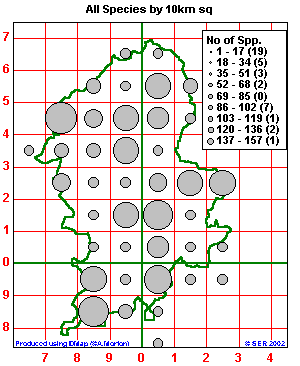
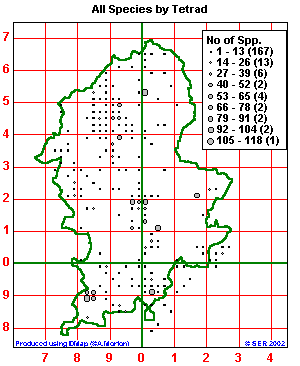
The two maps above show the number of species recorded in each 10km square (left) and tetrad (right) of the vice county. It can be seen that there are noticeable concentrations around SJ74 (Madeley, where H.W.Daltry lived), Cannock Chase and the south-west around Highgate Common.
This includes species which have been recorded in published lists which have either subsequently been redetermined, or there is no voucher material and the authors have serious doubts regarding their identification or synonymy. Further research and surveys may, in the future, prove these species to be Staffordshire residents, but they are not currently accepted on to the full list.
Species marked were included on the 1987 checklist produced by David Emley.
Recorded by Daltry in TNSFC 1945 and determined by H.Britten, but in TNSFC (1955) Daltry states “… hardly likely to be found in Staffordshire. The three specimens in question are probably only one of the common closely allied species.” The voucher specimen for this record needs to be located and checked if possible.
A collection of unconfirmed records from a variety of sources regarding locations in the north of the county and Cannock Chase have been received. There are no supporting voucher specimens for these species, therefore until further supporting evidence is forthcoming these species have been omitted from the main list and appear here (species marked * additionally have their own entry above):
| Andrena apicata | Ectemnius ruficornis | Mimesa bicolor* | Sphecodes longulus |
| Andrena simillima | Ectemnius sexcinctus | Nomada sexfasciata | Sphecodes spinulosus |
| Crossocerus distinguendus | Eucera longicornis* | Oxybelus mandibularis | Spilomena beata |
| Diodontus luperus | Lasioglossum pauxillum | Passaloecus singularis* | Vespula austriaca |
Species suffixed [1] have not been seen in Staffordshire since 1900 and may be extinct.
| Dryinidae | |
| Aphelopus atratus (Dalman, 1823) | |
| Aphelopus melaleucus (Dalman, 1818) | |
| Aphelopus serratus Richards, 1939 | |
| Anteon jurineanum Latreille, 1809 | |
| Lonchodryinus ruficornis (Dalman, 1818) | |
| Anteon fulviventre (Haliday, 1828) | |
| Anteon gaullei Keiffer, 1905 | |
| Anteon infectum (Haliday, 1837) | |
| Anteon pubicorne (Dalman, 1818) | |
| Gonatopus distinctus Keiffer, 1906 | |
| Gonatopus pedestris Dalman, 1818 | |
| Bethylidae | |
| Bethylus cephalotes Foerster, 1860 | common |
| Bethylus fuscicornis (Jurine, 1807) | local |
| Chrysididae | |
| Pseudomalus auratus (Linnaeus, 1758) | common |
| Elampus panzeri (Fabricius, 1804) | local |
| Omalus puncticollis (Mocsary, 1887) | Na |
| Hedychridium ardens (Latreille in Coquebert, 1801) | common |
| Chrysis angustula Schenck, 1856 | local |
| Trichrysis cyanea (Linnaeus, 1758) | common |
| Chrysis ignita (Linnaeus, 1758) | widespread |
| Chrysura radians (Harris, 1776) | Na |
| Chrysis ruddii Shuckard, 1837 | local |
| Chrysis rutiliventris Abeille de Perrin, 1879 | local |
| Chrysis viridula Linnaeus, 1761 | local |
| Pseudospinolia neglecta (Shuckard, 1836) | local |
| Cleptes semiauratus (Linnaeus, 1761) | Nb |
| Tiphiidae | |
| Tiphia minuta Vander Linden, 1827 | Nb |
| Methocha articulata Latreille, 1792 | Nb |
| Mutillidae | |
| Myrmosa atra Panzer, 1801 | local |
| Sapygidae | |
| Monosapyga clavicornis (Linnaeus, 1758) | Nb |
| Sapyga quinquepunctata (Fabricius, 1781) | local |
| Formicidae | |
| Hypoponera punctatissima (Roger, 1859) | naturalised |
| Myrmica lobicornis Nylander, 1846 | common |
| Myrmica rubra Linnaeus, 1758 | common |
| Myrmica ruginodis Nylander, 1846 | common |
| Myrmica scabrinodis Nylander, 1846 | common |
| Myrmica schencki Viereck, 1903 | Nb |
| Myrmica sulcinodis Nylander, 1846 | local |
| Leptothorax acervorum (Fabricius, 1793) | common |
| Myrmecina graminicola (Latreille, 1802) | local |
| Formica fusca Linnaeus, 1758 | common |
| Formica lemani Bondroit, 1917 local | |
| Formica rufa Linnaeus, 1761 local | |
| Lasius brunneus (Latreille, 1798) | Na |
| Lasius flavus (Fabricius, 1782) | common |
| Lasius fuliginosus (Latreille, 1798) | common |
| Lasius niger | common |
| Lasius umbratus (Nylander, 1846) | local |
| Pompilidae | |
| Dipogon bifasciatus (Geoffroy in Fourcroy, 1785) | RDB3 |
| Dipogon subintermedius (Magretti, 1886) | local |
| Dipogon variegatus (Linnaeus, 1758) | local |
| Caliadurgus fasciatellus (Spinola, 1808) | local |
| Priocnemis exaltata (Fabricius, 1775) | local |
| Priocnemis gracilis Haupt, 1927 | Nb |
| Priocnemis parvula Dahlbom, 1845 | local |
| Priocnemis perturbator (Harris, 1780) | local |
| Priocnemis pusilla Schioedte, 1837 | local |
| Priocnemis schioedtei Haupt, 1927 | Nb |
| Priocnemis susterai Haupt, 1927 | local |
| Pompilus cinereus (Fabricius, 1775) | local |
| Arachnospila anceps (Wesmael, 1851) | local |
| Arachnospila minutula (Dahlbom, 1842) | Nb |
| Arachnospila spissa (Schioedte, 1837) | local |
| Arachnospila trivialis (Dahlbom, 1843) | local |
| Evagetes crassicornis (Shuckard, 1837) | local |
| Anoplius concinnus (Dahlbom, 1845) | local |
| Anoplius infuscatus (Vander Linden, 1827) | local |
| Anoplius nigerrimus (Scopoli, 1763) | local |
| Anoplius viaticus (Linnaeus, 1758) | local |
| Episyron rufipes (Linnaeus, 1758) | local |
| Ceropales maculata (Fabricius, 1775) | local |
| Vespidae | |
| Odynerus spinipes (Linnaeus, 1758) | common |
| Ancistrocerus gazella (Panzer, 1798) | common |
| Ancistrocerus nigricornis (Curtis, 1826) | local |
| Ancistrocerus oviventris (Wesmael, 1836) | local |
| Ancistrocerus parietinus (Linnaeus, 1761) | common |
| Ancistrocerus parietum (Linnaeus, 1758) | common |
| Ancistrocerus trifasciatus (Mueller, 1776) | local |
| Symmorphus crassicornis (Panzer, 1798) | RDB3 |
| Symmorphus gracilis (Brulle, 1832) | local |
| Symmorphus bifasciatus (Linnaeus, 1761) | common |
| Vespa crabro Linnaeus, 1758 | local |
| Dolichovespula media (Retzius, 1783) | Na |
| Dolichovespula norwegica (Fabricius, 1781) | common |
| Dolichovespula sylvestris (Scopoli, 1763) | common |
| Dolichovespula saxonica (Fabricius, 1793) | RDB (K) |
| Vespula germanica (Fabricius, 1793) | common |
| Vespula rufa (Linnaeus, 1758) | common |
| Vespula vulgaris (Linnaeus, 1758) | common |
| Sphecidae | |
| Dryudella pinguis (Dahlbom, 1832) | local |
| Tachysphex pompiliformis (Panzer, 1805) | local |
| Trypoxylon attenuatum Smith, F., 1851 | common |
| Trypoxylon clavicerum Lepeletier & Serville, 1828 common | |
| Trypoxylon figulus | common |
| Crabro cribrarius (Linnaeus, 1758) | local |
| Crabro peltarius (Schreber, 1784) | local |
| Crossocerus annulipes (Lepeletier & Brulle, 1835) | common |
| Crossocerus capitosus (Shuckard, 1837) | local |
| Crossocerus cetratus (Shuckard, 1837) | local |
| Crossocerus dimidiatus (Fabricius, 1781) | local |
| Crossocerus elongatulus (Vander Linden, 1829) | common |
| Crossocerus megacephalus (Rossius, 1790) | common |
| Crossocerus nigritus Lepeletier & Brulle 1835 | local |
| Crossocerus ovalis Lepeletier & Brulle, 1835 | local |
| Crossocerus palmipes (Linnaeus, 1767) | Nb |
| Crossocerus podagricus (Vander Linden, 1829) | common |
| Crossocerus pusillus Lepeletier & Brulle, 1835 | common |
| Crossocerus quadrimaculatus (Fabricius, 1793) | common |
| Crossocerus styrius (Kohl, 1892) | local |
| Crossocerus tarsatus (Shuckard, 1837) | common |
| Crossocerus walkeri (Shuckard, 1837) | Nb |
| Crossocerus wesmaeli (Vander Linden, 1829) | common |
| Ectemnius cavifrons (Thomson, 1870) | common |
| Ectemnius cephalotes (Olivier, 1792) | common |
| Ectemnius continuus (Fabricius, 1804) | common |
| Ectemnius dives (Lepeletier & Brulle, 1834) | local |
| Ectemnius lapidarius (Panzer, 1804) | local |
| Ectemnius lituratus (Panzer, 1804) | local |
| Lindenius albilabris (Fabricius, 1793) | common |
| Lindenius panzeri (Vander Linden, 1829) | local |
| Entomognathus brevis (Vander Linden, 1829) | local |
| Rhopalum clavipes (Linnaeus, 1758) | local |
| Rhopalum coarctatum (Scopoli, 1763) | local |
| Oxybelus uniglumis (Linnaeus, 1758) | common |
| Mimumesa dahlbomi (Wesmael, 1852) | local |
| Mimesa equestris (Fabricius, 1804) | common |
| Mimesa lutarius (Fabricius, 1787) | common |
| Psenulus concolor (Dahlbom, 1843) | local |
| Psenulus pallipes (Panzer, 1798) | common |
| Spilomena troglodytes (Vander Linden, 1829) | common |
| Stigmus solskyi Morawitz, 1864 | local |
| Pemphredon inornata Say, 1824 | common |
| Pemphredon lethifera (Shuckard, 1837) | common |
| Pemphredon lugubris (Fabricius, 1793) | common |
| Diodontus insidiosus Spooner, 1938 | RDB3 |
| Diodontus minutus (Fabricius, 1793)[1] | common |
| Diodontus tristis (Vander Linden, 1829)[1] | local |
| Passaloecus corniger Shuckard, 1837 | common |
| Passaloecus gracilis (Curtis, 1834) | common |
| Passaloecus insignis (Vander Linden, 1829) | local |
| Passaloecus monilicornis Dahlbom, 1842 | local |
| Passaloecus singularis Dahlbom, 1844 | common |
| Ammophila sabulosa (Linnaeus, 1758) | local |
| Mellinus arvensis (Linnaeus, 1758) | common |
| Nysson dimidiatus Jurine, 1807 | Nb |
| Nysson spinosus (Forster, 1771) | common |
| Nysson trimaculatus (Rossius, 1790) | Nb |
| Gorytes quadrifasciatus (Fabricius, 1804) | local |
| Harpactus tumidus (Panzer, 1806) | local |
| Argogorytes mystaceus (Linnaeus, 1761) | local |
| Cerceris arenaria (Linnaeus, 1758) | common |
| Cerceris rybyensis (Linnaeus, 1771) | local |
| Philanthus triangulum (Fabricius, 1775) | RDB2 |
| Apidae | |
| Colletes daviesanus Smith, F., 1846 | common |
| Colletes succinctus (Linnaeus, 1758) | local |
| Hylaeus brevicornis Nylander, 1852 | local |
| Hylaeus communis Nylander, 1852 | local |
| Hylaeus confusus Nylander, 1852 | local |
| Hylaeus hyalinatus Smith, 1842 | local |
| Andrena angustior (Kirby, 1802) | local |
| Andrena barbilabris (Kirby, 1802) | local |
| Andrena bicolor Fabricius, 1775 | common |
| Andrena bimaculata (Kirby, 1802) | Nb |
| Andrena chrysosceles (Kirby, 1802) | local |
| Andrena cineraria (Linnaeus, 1758) | local |
| Andrena clarkella (Kirby, 1802) | common |
| Andrena coitana (Kirby, 1802) | local |
| Andrena denticulata (Kirby, 1802) | local |
| Andrena dorsata (Kirby, 1802) | local |
| Andrena flavipes Panzer, 1799[1] | local |
| Andrena fucata Smith, 1847 | local |
| Andrena fulva (Muller in Allioni, 1776) | common |
| Andrena fuscipes (Kirby, 1802) | local |
| Andrena haemorrhoa (Fabricius, 1781) | common |
| Andrena helvola (Linnaeus, 1758) | local |
| Andrena humilis Imhoff, 1832 | Nb |
| Andrena labiata Fabricius, 1781 | Na |
| Andrena lapponica Zetterstedt, 1838 | local |
| Andrena minutula (Kirby, 1802) | common |
| Andrena nigriceps (Kirby, 1802 | Nb |
| Andrena nigroaenea (Kirby, 1802) | common |
| Andrena similis Smith, 1849 | Nb |
| Andrena ovatula (Kirby, 1802) | common |
| Andrena praecox (Scopoli, 1763) | local |
| Andrena nitida (Muller, 1776) | common |
| Andrena rosae Panzer, 1801 | RDB2 |
| Andrena semilaevis Perez, 1903 | common |
| Andrena scotica Perkins, R.C.L., 1916 | common |
| Andrena subopaca Nylander, 1848 | common |
| Andrena synadelpha Perkins, 1914 | local |
| Andrena tarsata Nylander, 1848 | local |
| Andrena tibialis (Kirby, 1802) | Na |
| Andrena trimmerana (Kirby, 1802) | Nb |
| Andrena varians (Kirby, 1802) | Nb |
| Andrena wilkella (Kirby, 1802) | common |
| Andrena nigrospina Thomson, 1872 | pRDB |
| Halictus rubicundus (Christ, 1791) | common |
| Halictus tumulorum (Linnaeus, 1758) | common |
| Lasioglossum albipes (Fabricius, 1781) | common |
| Lasioglossum brevicorne Schenck, 1870 | RDB3 |
| Lasioglossum calceatum (Scopoli, 1763) | common |
| Lasioglossum cupromicans (Perez, 1903) | local |
| Lasioglossum fratellum (Perez, 1903) | common |
| Lasioglossum fulvicorne (Kirby, 1802) | local |
| Lasioglossum laevigatum (Kirby, 1802) | common |
| Lasioglossum lativentre (Schenck, 1853) | unknown |
| Lasioglossum leucopus (Kirby, 1802) | local |
| Lasioglossum leucozonium (Schrank, 1781) | common |
| Lasioglossum minutissimum (Kirby, 1802) | common |
| Lasioglossum morio (Fabricius, 1793) | common |
| Lasioglossum nitidiusculum (Kirby, 1802) | local |
| Lasioglossum parvulum (Schenck, 1853) | common |
| Lasioglossum punctatissimum (Schenck, 1853) | local |
| Lasioglossum quadrinotatum (Kirby, 1802) | Na |
| Lasioglossum rufitarse (Zetterstedt, 1838) | local |
| Lasioglossum smeathmanellum (Kirby, 1802) | unknown |
| Lasioglossum villosulum (Kirby, 1802) | common |
| Lasioglossum xanthopus (Kirby, 1802) | Nb |
| Sphecodes crassus Thomson, 1870 | Nb |
| Sphecodes ephippius (Linnaeus, 1767) | common |
| Sphecodes geoffrellus (Kirby, 1802) | common |
| Sphecodes ferruginatus von Hagens, 1882 | Nb |
| Sphecodes gibbus (Linnaeus, 1758) | common |
| Sphecodes hyalinatus von Hagens, 1882 | common |
| Sphecodes miniatus von Hagens, 1882 | Nb |
| Sphecodes monilicornis (Kirby, 1802) | local |
| Sphecodes niger von Hagens, 1874 | RDB3 |
| Sphecodes pellucidus Smith, F., 1845 | local |
| Sphecodes puncticeps Thomson, 1870 | unknown |
| Sphecodes reticulatus Thomson, 1870 | Na |
| Sphecodes rubicundus von Hagens, 1875 | Na |
| Melitta haemorrhoidalis (Fabricius, 1775) | local |
| Melitta leporina (Panzer, 1779) | local |
| Anthidium manicatum (Linnaeus, 1758) | common |
| Stelis phaeoptera (Kirby, 1802) | RDB2 |
| Stelis punctulatissima (Kirby, 1802) | Nb |
| Chelostoma florisomne (Linnaeus, 1758) | local |
| Osmia bicolor (Schrank, 1781)[1] | Nb |
| Osmia caerulescens (Linnaeus, 1758) | common |
| Osmia leaiana (Kirby, 1802) | common |
| Osmia rufa (Linnaeus, 1758) | common |
| Hoplitis claviventris (Thomson, 1872) | common |
| Megachile centuncularis (Linnaeus, 1758) | local |
| Megachile circumcincta (Kirby, 1802) | common |
| Megachile ligniseca (Kirby, 1802) | common |
| Megachile versicolor Smith, F., 1844 | local |
| Megachile willughbiella (Kirby, 1802) | common |
| Coelioxys elongata Lepeletier, 1841 | local |
| Nomada fabriciana (Linnaeus, 1767) | common |
| Nomada flava Panzer, 1798 | common |
| Nomada flavoguttata (Kirby, 1802) | common |
| Nomada flavopicta (Kirby, 1802) | Nb |
| Nomada fulvicornis Fabricius, 1793 | RDB3 |
| Nomada goodeniana (Kirby, 1802) | common |
| Nomada lathburiana (Kirby, 1802) | RDB3 |
| Nomada leucophthalma (Kirby, 1802) | local |
| Nomada marshamella (Kirby, 1802) | common |
| Nomada obtusifrons Nylander, 1848 | local |
| Nomada panzeri Lepeletier, 1841 | common |
| Nomada integra Brulle, 1832 | Na |
| Nomada ruficornis (Linnaeus, 1758) | local |
| Nomada rufipes Fabricius, 1793 | common |
| Nomada sheppardana (Kirby, 1802) | unknown |
| Nomada signata Jurine, 1807 | RDB2 |
| Nomada striata Fabricius, 1793 | local |
| Nomada ferruginata (Linnaeus, 1767)[1] | RDB1 |
| Epeolus cruciger (Panzer, 1799) | local |
| Epeolus variegatus (Linnaeus, 1758) | local |
| Anthophora furcata (Panzer, 1798) | unknown |
| Anthophora plumipes (Pallas, 1772) | common |
| Anthophora retusa (Linnaeus, 1758)[1] | RDB1 |
| Melecta albifrons (Forster, 1771) | local |
| Bombus distinguendus Morawitz, 1869 | Nb |
| Bombus hortorum (Linnaeus, 1761) | common |
| Bombus humilis Illeger, 1806 | local |
| Bombus jonellus (Kirby, 1802) | local |
| Bombus lapidarius (Linnaeus, 1758) | common |
| Bombus lucorum (Linnaeus, 1761) | common |
| Bombus monticola Smith, 1849 | local |
| Bombus muscorum (Linnaeus, 1758) | local |
| Bombus pascuorum (Scopoli, 1763) | common |
| Bombus pratorum (Linnaeus, 1761) | common |
| Bombus ruderarius (Mueller, 1776) | local |
| Bombus ruderatus (Fabricius, 1775) | Nb |
| Bombus soroeensis (Fabricius, 1777) | local |
| Bombus subterraneus (Linnaeus, 1758) | Na |
| Bombus sylvarum (Linnaeus, 1761) | Nb |
| Bombus terrestris (Linnaeus, 1758) | common |
| Bombus magnus Vogt, 1911 | unknown |
| Bombus barbutellus (Kirby, 1802) | common |
| Bombus bohemicus (Seidl, 1837) | common |
| Bombus campestris (Panzer, 1800) | common |
| Bombus rupestris (Fabricius, 1793) | Nb |
| Bombus sylvestris (Lepeletier, 1833) | common |
| Bombus vestalis (Geoffroy in Fourcroy, 1785) | common |
| Apis mellifera Linnaeus, 1758 | common |
This family has undergone many taxonomic changes recently, with many species listed in Kloet and Hinks now combined.
All species except Aphelopus melaleucus and A.serratus refer to records from before 1940 and almost all are single occurrences. Dryinids are probably overlooked and have not been investigated thoroughly for this checklist. They are retained on the list for completeness. More work is required before this family list is viewed as anything other than provisional.
All Dryinids parasitize Homopteran bugs, the female laying its eggs between two overlapping sclerites of the host (usually a nymph).
Aphelopus atratus (Dalman, 1823)
Recorded once in Staffordshire in 1939.
Aphelopus melaleucus (Dalman, 1818)
Recorded once in Staffordshire in 2002.
Aphelopus serratus Richards, 1939
Recorded twice in Staffordshire.
(1 record before 1951; 1 record between 1951 and 1990)
Anteon jurineanum Latreille, 1809= Anteon cursor
Recorded once in Staffordshire before 1939.
Lonchodryinus ruficornis (Dalman, 1818)= Prenanteon basalis and P.subapterus
Recorded in Staffordshire 3 times.
(3 records before 1951)
Anteon fulviventre (Haliday, 1828)= Chelogynus fulviventris
Recorded once in Staffordshire before 1939.
Anteon gaullei Keiffer, 1905= Chelogynus cameroni
Recorded once in Staffordshire before 1939.
Anteon infectum (Haliday, 1837)= Chelogynus infectus
Recorded once in Staffordshire before 1939.
Anteon pubicorne (Dalman, 1818)= Chelogynus lucidus
Recorded twice in Staffordshire.
(1 record before 1951; 1 record since 1990)
Gonatopus distinctus Keiffer, 1906
Recorded once in Staffordshire before 1931.
Gonatopus pedestris Dalman, 1818
Recorded once in Staffordshire before 1931.
Bethylus cephalotes Foerster, 1860
National Status: common ; Archer Status: unclassified
Recorded in Staffordshire 3 times.
(2 records before 1951; 1 record since 1990)A small dark wasp parasitic on lepidopterous larvae. A recent specimen was swept from decaying sulphur polypore (Laetiporus sulphureus) on oak.
Bethylus fuscicornis (Jurine, 1807)
National Status: local ; Archer Status: unclassified
Recorded twice in Staffordshire.
(1 record before 1951; 1 record between 1951 and 1990)
A small dark wasp parasitic on lepidopterous larvae. One from Staffordshire has been recorded as bred from a dipterous pupa but the exuviae are not with the specimen.
The genus Chrysis continues to be taxonomically problematic. M.E.Archer has researched the genus in depth and persistent difficulties have been periodically discussed in BWARS newsletters which also contain reviews of relevant literature. A number of Staffordshire specimens have been confirmed by him but others have yet to be submitted.
Pseudomalus auratus (Linnaeus, 1758) = Omalus auratus
National Status: common ; Archer Status: unclassified
Recorded in Staffordshire 3 times.
(2 records before 1951; 1 record since 1990)
A cuckoo wasp found in a variety of situations. Its main hosts are thought to include Pemphredon lethifer, Pemphredon inornata and Trypoxylon spp., all of which are aerial nesters in dead wood and cut stems.
Elampus panzeri (Fabricius, 1804)
National Status: local ; Archer Status: unclassified
Recorded in Staffordshire 7 times.
(3 records before 1951; 4 records since 1990)
A small cuckoo wasp found mainly in sandy areas in Staffordshire as elsewhere, where it is associated with Psen and Mimesa spp.
Omalus puncticollis (Mocsary, 1887)
National Status: Na ; Archer Status: unclassified
Recorded once in Staffordshire in 2000.
A cuckoo wasp found in a variety of situations. In this county it has been taken by sweeping bushes at the interface of deciduous woodland and coniferous plantation. Its main hosts are unknown although they are thought to include aerial nesting solitary wasps (Sphecidae).
Hedychridium ardens (Latreille in Coquebert, 1801)
National Status: common ; Archer Status: universal
Recorded in Staffordshire 5 times.
(1 record before 1951; 4 records since 1990)
A small cuckoo wasp found in sandy situations (including a golf course in the county). Its main host is the sphecid wasp Tachysphex pompiliformis, which hunts grasshopper nymphs.
Chrysis angustula Schenck, 1856
National Status: local ; Archer Status: unclassified
Recorded in Staffordshire 6 times.
(5 records between 1951 and 1990; 1 record since 1990)
A cuckoo wasp found in a variety of situations. Known hosts include Ancistrocerus trifasciatus and Crabro spp.
Trichrysis cyanea (Linnaeus, 1758)
National Status: common ; Archer Status: unclassified
Recorded in Staffordshire 18 times.
(8 records before 1951; 2 records between 1951 and 1990; 8 records since 1990)
A small blue-green cuckoo wasp whose hosts include both solitary bee and wasps which have aerial nests. These include Trypoxylon spp., Pemphredon spp. and Chelostoma florisomne. This wasp is found in a wide variety of situations.
Chrysis ignita (Linnaeus, 1758)
National Status: widespread ; Archer Status: unclassified
Recorded in Staffordshire 19 times.
(10 records before 1951; 2 records between 1951 and 1990; 7 records since 1990)
Material provisionally identified has, in a number of collections, been designated as ‘C.ignita agg.’. Some of this Staffordshire material remains to be examined. A cuckoo wasp found in a variety of situations, often on walls and other buildings. Known hosts include Ancistrocerus spp.
Chrysura radians (Harris, 1776)
National Status: Na ; Archer Status: unclassified
Recorded in Staffordshire 4 times.
(4 records before 1951)
A blue and red parasitoid wasp usually seen around old wooden posts, stumps and dead trees where the hosts (Osmia spp.) nest.
Chrysis ruddii Shuckard, 1837
National Status: local ; Archer Status: unclassified
Recorded once in Staffordshire before 1931.
A cuckoo wasp found in a variety of situations, often on walls and other buildings. Known hosts include Ancistrocerus spp.
Chrysis rutiliventris Abeille de Perrin, 1879
National Status: local ; Archer Status: unclassified
Recorded in Staffordshire 3 times.
(3 records between 1951 and 1990)
A cuckoo wasp found in a variety of situations, often on walls and other buildings. Known hosts include Ancistrocerus spp.
Chrysis viridula Linnaeus, 1761
National Status: local ; Archer Status: scarce
Recorded twice in Staffordshire.
(2 records before 1951)
A cuckoo wasp known to be associated with Odynerus spinipes and Odynerus melanocephalus.
Pseudospinolia neglecta (Shuckard, 1836)= Spinolia neglectus
National Status: local ; Archer Status: unclassified
Recorded once in Staffordshire before 1931.
A cuckoo wasp that attacks Odynerus spinipes in vertical sandy faces.
Cleptes semiauratus (Linnaeus, 1761)
National Status: Nb ; Archer Status: unclassified
Recorded twice in Staffordshire.
(2 records before 1951)
A cuckoo wasp that is associated with the sawfly Nematus ribesii.
Tiphia minuta Vander Linden, 1827
National Status: Nb ; Archer Status: widespread
Recorded in Staffordshire 6 times.
(6 records since 1990)
A small solitary wasp which is thought to parasitise beetle larvae from the Scarabaeidae family. These beetles are coprophores and are found in excavated chambers underneath dung. The female wasp is thought to enter the chambers and attack the larvae.
Methocha articulata Latreille, 1792= M.ichneumonides
National Status: Nb ; Archer Status: scarce
A wingless solitary wasp parasitic on tiger beetle larvae (Cicindellidae) in their burrows. In Staffordshire it is restricted to heathlands in the southern half of the County.
Myrmosa atra Panzer, 1801
National Status: local ; Archer Status: widespread
Recorded in Staffordshire 29 times.
(6 records before 1951; 22 records since 1990)
A small wasp, the female being wingless parasitoid associated with other aculeate Hymenoptera, including both sphecid wasps and halictine bees. Found throughout Staffordshire at suitable locations.
Monosapyga clavicornis (Linnaeus, 1758)= Sapyga clavicornis
National Status: Nb ; Archer Status: scarce
Recorded in Staffordshire 8 times.
(6 records before 1951; 2 records since 1990)
A small brood parasite of solitary bees, in the UK Chelostoma florisomne is thought to be the main host. The most recent record from Oakwood Pastures SWT Nature Reserve, where active males were recorded on and around a dead oak tree.
Sapyga quinquepunctata (Fabricius, 1781)
National Status: local ; Archer Status: widespread
Recorded in Staffordshire 7 times.
(4 records before 1951; 1 record since 1990)
A red, black and white spotted wasp found in a variety of situations (including wooden fence posts and a greenhouse in Staffordshire) which is a brood parasite of bees, in particular Osmia spp. and Chelostoma spp. It has quite a widespread distribution in England and Wales.
The identification of representatives from some genera has been problematic over the course of time and recent work on the genus Lasius has revealed new species closely related to Lasius niger & L.alienus (Orledge,G.M. in BWARS 2003 Spring Newsletter, page 2).
Work to assess the status of Lasius platythorax (Seifert 1991) which is very similar to L.niger and Lasius psammophilus (Seifert 1992) which closely resembles L.alienus is ongoing and pending examination of available Staffs material by specialists or with the help of new keys, it will be necessary to provisionally re-name our Staffordshire species as L.niger s.l. and L.alienus s.l.
Hypoponera punctatissima (Roger, 1859)
National Status: naturalised
An introduced ant usually found in houses or greenhouses, recorded once in large numbers in a house in Stoke-on-Trent.
Myrmica lobicornis Nylander, 1846
National Status: common ; Archer Status: unclassified
A small red ant which has a localised distribution throughout Britain. It is often found in isolated colonies in open woodland, pasture and moorland. There is only one recent record from a moorland in Staffordshire.
Myrmica rubra Linnaeus, 1758
National Status: common ; Archer Status: unclassified
Recorded in Staffordshire 18 times.
(3 records before 1951; 10 records between 1951 and 1990; 5 records since 1990)
A small red ant which is common throughout England. It can be found in a variety of situations including gardens and under stones in pasture, but may be more restricted in its choice of habitats in Staffordshire than M.ruginodis.
Myrmica ruginodis Nylander, 1846
National Status: common ; Archer Status: unclassified
Recorded in Staffordshire 36 times.
(3 records before 1951; 21 records between 1951 and 1990; 12 records since 1990)
A small red ant, found throughout Britain and seemingly very common. It can be found in Staffordshire in a variety of cultivated and uncultivated habitats, regularly occurring on rough ground in grass tussocks and rotten wood.
Myrmica scabrinodis Nylander, 1846
National Status: common ; Archer Status: unclassified
Recorded in Staffordshire 29 times.
(5 records before 1951; 9 records between 1951 and 1990; 15 records since 1990)
A small red ant which is widespread in England and adapted to a variety of habitats. Common in Staffordshire, it appears to tolerate more arid conditions than other Myrmica sp, short turf grassland being a typical habitat. It may even be found in boggy places were it constructs nests consisting of mud-plastered walls.
Myrmica schencki Viereck, 1903
National Status: Nb ; Archer Status: unclassified
A small red ant which is more common in the south of England. It dwells in sandy sheltered areas but has not been recorded in Staffordshire since the 1930s. Lack of recording effort may be a factor here.
Myrmica sulcinodis Nylander, 1846
National Status: local ; Archer Status: unclassified
Recorded in Staffordshire 3 times.
(3 records before 1951)
A red ant of northern heather moorlands. It has not been recorded in the County for over fifty years, but again, recording effort (or lack of it) may be a factor.
Leptothorax acervorum (Fabricius, 1793)
National Status: common ; Archer Status: unclassified
Recorded in Staffordshire 10 times.
(6 records before 1951; 1 record between 1951 and 1990; 3 records since 1990)
A small red-brown ant generally widespread in Britain. In Staffordshire it is frequently associated with trees, small colonies often occurring in the bark of fallen branches or rotting stumps. It has also been found in association with old heather on heathland.
Myrmecina graminicola (Latreille, 1802)
National Status: local ; Archer Status: unclassified
A localised southern species generally found under stones, in cliffs and in open woodland. It is often found with other ant species. It has not been recorded in Staffordshire for nearly 100 years. Large scale changes of land use near its old site may indeed have resulted in its loss.
Formica fusca Linnaeus, 1758
National Status: common ; Archer Status: unclassified
Recorded in Staffordshire 10 times.
(1 record before 1951; 3 records between 1951 and 1990; 6 records since 1990)
A black ant found most commonly in open heathland and grassland. It is common in the south of England but recent recording in Staffordshire suggests that it may be less frequent in the county than F.lemani.
Formica lemani Bondroit, 1917
National Status: local ; Archer Status: unclassified
Recorded in Staffordshire 34 times.
(2 records before 1951; 22 records between 1951 and 1990; 10 records since 1990)
A black ant found most commonly in open heathland and moorland. It is commoner in the north of Britain and is easily confused with F.fusca. Both species are widespread within Staffordshire.
Formica rufa Linnaeus, 1761 – Red Wood Ant
National Status: local ; Archer Status: unclassified
Recorded in Staffordshire 11 times.
(2 records before 1951; 9 records since 1990)
A large and conspicuous species that builds huge nests in open woodlands. In Staffordshire it occurs only along the edges of open conifer woodlands and is found at three sites.
Lasius brunneus (Latreille, 1798)
National Status: Na ; Archer Status: unclassified
A small brown ant. This species is a tree dwelling species, typically nesting in old oak trees in parklands. A single worker was found in the South of the County at Himley Hall in dead wood within the Parkland. This is the most northerly record for the United Kingdom.
Lasius flavus (Fabricius, 1782)
National Status: common ; Archer Status: unclassified
Recorded in Staffordshire 25 times.
(4 records before 1951; 6 records between 1951 and 1990; 15 records since 1990)
A yellow subterranean ant which is widespread over England. It builds earth-mounds in pastures and is considered a good indicator of old grasslands.
Lasius fuliginosus (Latreille, 1798) – Jet Black Ant
National Status: common ; Archer Status: unclassified
A shining black ant which forms nests in trees, stumps and hedges. It is widely distributed in southern England although it has not been recorded in Staffordshire for 100 years. This may well be due to surveying oversight as it is not infrequent in areas of Worcestershire very close to Kinver in the South of the county.
Lasius niger sensu lato
National Status: common ; Archer Status: unclassified
Recorded in Staffordshire 36 times.
(3 records before 1951; 8 records between 1951 and 1990; 25 records since 1990)
A very common black ant which is ubiquitous throughout lowland areas of Britain. It is found in a variety of habitats and is often recorded from gardens and in houses.
Lasius umbratus (Nylander, 1846)
National Status: local ; Archer Status: unclassified
A small brown ant nesting at the base of old stumps and under boulders. There are no recent records for this species in the County. This may be down both to lack of recording effort and also to the retiring nature of this ant which is most often seen when swarming.